Mobile CRM for Field Sales Teams: Eliminate Manual Research With Real-Time Buying Signal Detection
Your field sales reps spend 60–70% of their working hours on tasks that don't generate revenue. For a 10-person sales team, that's roughly 6–7 full-time equivalents lost to manual lead research across fragmented tools instead of having conversations with prospects. The annual cost? €480,000–€700,000 wasted on activities that produce zero direct revenue. A standard mobile CRM manages contacts, but it doesn't address the core problem: buying signals scattered across email, LinkedIn, messaging, and voice channels that your reps never see in time.
Right now, a prospect might engage with your company across four channels simultaneously—opening your marketing email, visiting your pricing page, engaging with your LinkedIn content, and mentioning a pain point in an industry Slack community. That's 15 micro-interactions signaling genuine buying intent. But because these signals live in disconnected systems, your reps see only the last touchpoint. They reach out late, with generic messaging, and miss the buying window entirely.
This guide shows you how a signal-first mobile CRM transforms field sales by extracting real-time buying signals from all channels and feeding them directly into a prioritized prospect list. Instead of spending two hours piecing together intent from LinkedIn, email, ZoomInfo, and your CRM, reps spend 30 minutes reviewing context, then make 15 calls—six of which are with prospects actively in-market. Response rates jump from 1–3% to 8–12%, qualified meetings increase 40%+, and reps reclaim 6–8 hours per week for actual selling conversations.
Why Traditional Mobile CRM Misses the Real Bottleneck
Contact Records Don't Replace Signal Detection
A typical field rep's morning follows a predictable pattern: open LinkedIn, scan 50 target accounts for activity; cross-reference ZoomInfo for recent job changes; search email for pain point mentions; toggle to the mobile CRM to log notes. By 10 AM, two hours are gone—and they haven't made a single outbound call. Your mobile CRM contains their contact records, but it's blind to where actual buying signals are happening.
The problem isn't that your contacts aren't in the system. It's that the behavioral signals indicating buying readiness exist everywhere except in your mobile CRM. Email engagement (opens, clicks, reply sentiment), LinkedIn activity (profile views, content interaction, connection timing), messaging mentions, call recordings, event registrations—all of these are being generated right now. None of them are being aggregated into a unified view that helps reps prioritize who to call first.
The result is that your highest-value prospects—those showing buying intent across multiple channels simultaneously—are invisible. A prospect actively evaluating your product receives the same templated cold email as someone who has never heard of you. Your team loses deals they should have won because the signals existed but nobody saw them.
Static Firmographics Can't Identify In-Market Prospects
Most mobile CRM solutions prioritize prospects based on static attributes: company size, industry, location, job title, funding stage. These firmographic data points never answer the question that matters most: Is this prospect actively in-market right now? A Series B SaaS company with 80 employees in your target vertical might be a perfect ICP fit on paper—but if they just committed to a 3-year contract with your competitor, that firmographic data is worthless today.
Without dynamic, real-time signals, your field sales team defaults to volume-based outreach. Reps blast generic sequences to thousands of contacts. Response rates stagnate at 1–3%. Your team books meetings with prospects who aren't actually evaluating solutions. Pipeline moves slowly because the majority of outreach targets prospects in the wrong buying stage. The fundamental problem isn't the size of your list—it's the absence of signal intelligence. Your team cannot distinguish between a prospect ready to buy next quarter and one who won't buy for two years.
Data Decay and Tool Fragmentation Multiply the Problem
B2B contact data deteriorates at roughly 30% per year. Within 12 months, nearly one-third of your mobile CRM records are outdated or incorrect. Contacts change jobs (average tenure for a B2B buyer is 2.5 years), companies get acquired, phone numbers become invalid, email addresses bounce. Your field sales team encounters the consequences daily: bounced emails, no longer at company responses, calls to wrong numbers, duplicate records, conflicting information between LinkedIn and your CRM.
Fixing this requires continuous enrichment, deduplication, and validation—work that either never happens consistently (when manual) or demands expensive third-party tools that create additional silos and privacy concerns. One incorrect contact address wastes rep time; multiply by a 100-prospect list, and you've lost days to dead-end calls. The deeper issue: your mobile CRM data quality depends entirely on what reps manually enter. Reps avoid data entry. They log the minimum required to move a deal forward. Without automated data capture from actual communication channels, your CRM becomes stale faster than any manual enrichment process can fix it.
What Field Sales Teams Actually Need: Building a Signal-First Mobile CRM
The solution isn't incrementally better contact management. It's an intelligent signal extraction layer that brings real-time buying signals into your mobile CRM without requiring reps to do the research manually. This is fundamentally different architecture from traditional mobile CRM design.
Extracting Intent Signals From All Communication Channels
Buying signals are generated constantly within your organization. They exist in email threads (open rates, link clicks, reply sentiment), LinkedIn interactions (profile views, content engagement, connection requests), messaging platforms (Slack, Teams, WhatsApp mentions), voice calls (conversation topics, objections, intent language), and event registrations. These signals already exist—they're just scattered across disconnected systems where your reps can't see them.
A signal extraction layer connects to all these channels, extracts structured intent signals, and normalizes them into a common format. This single approach replaces the alternative of buying additional point solutions. Instead of stacking a conversation intelligence platform, a LinkedIn analytics tool, and an enrichment provider on top of your existing stack, you unify the signals your organization already generates.
Dynamic Prioritization Based on Real Behavior, Not Paper Attributes
Once signals are aggregated, your mobile CRM can rank prospects based on actual buying behavior in real-time. Top prospects show multiple intent signals simultaneously: recent email engagement plus LinkedIn profile visits plus pricing page research plus relevant job posting activity. This approach allows your reps to focus on the 20% of prospects generating 80% of the signals instead of blasting all 1,000 contacts on the list.
The practical impact is immediate: reps focus on prospects ready to buy now, not prospects who fit the ICP profile on paper. Meeting response rates increase because outreach timing is based on actual engagement, not generic attributes. Pipeline velocity improves because your field sales team is pursuing qualified interest, not guessing.
Automated Data Capture That Solves the Decay Problem
Signal extraction also addresses the data quality issue automatically. When contact intelligence is captured directly from communication channels—email, calls, messages—and fed into your mobile CRM without requiring rep input, your records stay current. If a rep calls someone who's recently changed roles, that change gets captured and updated automatically. If an email bounces, the system flags it. If a prospect mentions they're now in a different function, that gets recorded.
This eliminates the compounding cost of stale data. No more bounced emails to outdated addresses. No more duplicate records causing confusion. Your mobile CRM becomes a living source of truth instead of a repository of outdated information.
Implementing Signal Extraction for Your Field Sales Mobile CRM
Step 1: Audit Where Buying Signals Are Currently Lost
Start by documenting the tools your field sales team currently uses: mobile CRM, email sequencer, LinkedIn Sales Navigator, enrichment provider, dialer, meeting scheduler, conversation intelligence, proposal tool. For each tool, identify what signals it captures and whether those signals automatically flow back into your mobile CRM to influence prospect prioritization.
This audit typically reveals the same pattern: most signals (email engagement, LinkedIn activity, call recordings, message sentiment) remain trapped in isolated systems and never inform how prospects are ranked or which contacts reps should contact first. Your mobile CRM contains contact records, but it lacks visibility into the behavioral signals that indicate genuine buying readiness. This fragmentation is the root cause of the manual research waste and low pipeline quality across most field sales teams.
Step 2: Deploy a Signal Normalization Layer
A unified signal extraction layer connects to all your communication channels—email, LinkedIn, messaging, mobile CRM, voice calls, events—and captures structured intent signals. It identifies engagement trends (how active is this prospect right now?), pain point mentions (what problems are they discussing?), role transitions (is this contact still relevant?), organizational growth patterns (are they expanding investments?), and competitive awareness (are they evaluating alternatives?).
This layer normalizes all signals into a standardized format so they feed into your mobile CRM as a unified buying signal score per contact. Importantly, this doesn't require replacing your existing tools. The layer integrates with them. It sits beneath your tech stack, not replacing it—extracting intelligence from all channels and distributing it to whatever tools your field sales team uses.
Step 3: Surface Prioritized Prospects in Your Mobile CRM
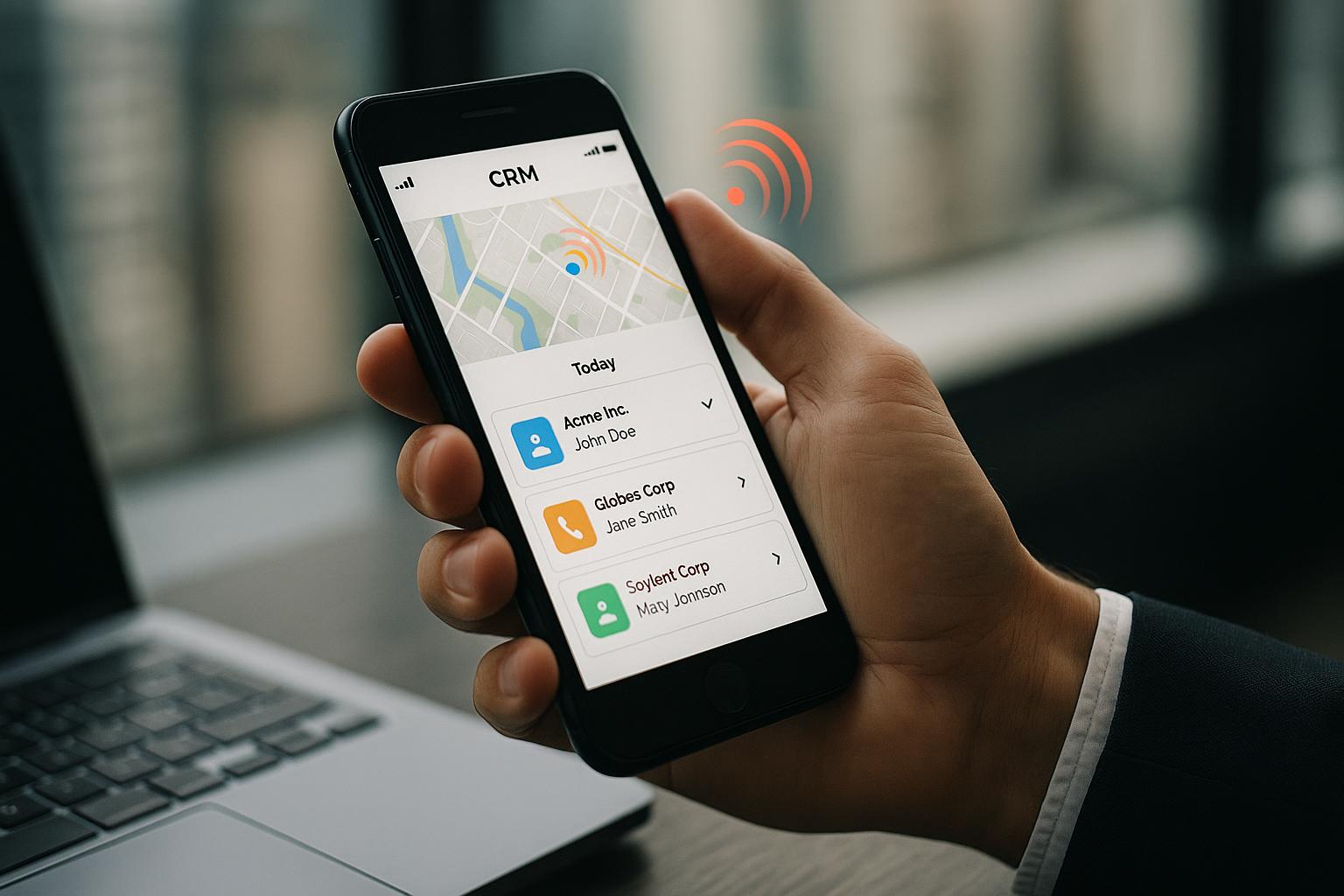
Once signals are normalized and flowing into your mobile CRM, field reps see an automatically prioritized contact list on their mobile app, updated in real-time. Prospects with the highest signal scores appear first. When reps tap into a contact, they see firmographic data, signal history (which activities triggered the ranking), suggested next actions, and relevant context from recent interactions.
This workflow replaces the entire manual research process. Instead of spending two hours across LinkedIn, email, and ZoomInfo, reps spend 30 minutes reviewing context, then make 15 calls. Of those calls, six are with prospects actively in-market—not cold contacts. The prioritization is transparent. Reps understand why each prospect ranks where they do.
| Capability | Traditional Mobile CRM | Signal-First Mobile CRM |
| Core Data Source | Contact records, job titles, company info | Contact records + real-time behavioral signals |
| Signal Sources | Email address, phone (static entry) | Email engagement, LinkedIn activity, voice data, message sentiment |
| Prioritization Method | Company size, industry, funding stage | Dynamic intent scores based on current buying behavior |
| Data Currency | Manual entry—30% annual decay | Automated capture—remains current across channels |
| Time Per Contact Review | Manual research across 6+ tools (2+ hours/day) | Auto-prioritized list review + research (30 min total) |
| Integration Model | Point integrations (limited data flow) | Unified signal layer (all channels, one source) |
Real-World Transformation: Distributed Field Sales Team Case Study
Before: Manual Research Consuming 50 Hours Per Week
A distributed field sales team of five SDRs across two Western European countries follows the standard morning routine. One rep checks LinkedIn to see activity across 50 target accounts. They cross-reference ZoomInfo for recent role changes. They scan email for pain point discussions. They log notes in the mobile CRM. By 10 AM, two hours are consumed.
They make 10 calls that morning. Of those, perhaps one prospect is actively evaluating. The rest are early-stage or not yet in-market. Meeting response rates hover at 1–3%. The team attributes this to bad lists or poor timing, but the actual cause is that 15 micro-signals indicating buying intent existed—the team simply never detected them. For a 5-person SDR team, this represents roughly 50 hours per week spent on research rather than conversations. At €70,000 fully loaded cost per SDR, that's €35,000+ per quarter of productivity lost to manual information gathering that generates no revenue.
Mobile CRM data deteriorates throughout the quarter. Email bounces increase. Contacts change jobs. Phone numbers become invalid. Nobody owns the data quality problem because fixing it requires continuous enrichment and deduplication work that nobody has time for. The team is trapped in a cycle of low-quality outbound that feels increasingly unsustainable as pipeline targets rise.
After: Signal-Driven Prioritization and 40% More Qualified Meetings
The same team implements a signal-first mobile CRM approach. When an SDR logs into their mobile app, they see a prioritized list of 30 prospects ranked by real-time buying signals. The top 10 are high-priority: they've engaged with relevant content in the last 72 hours, mentioned a problem your product solves, or showed activity from someone in a relevant role. The rep spends 30 minutes reviewing context (not two hours researching), then makes 15 calls.
Of those 15 calls, six connect with prospects actively in-market—not cold outreach. Response rates jump from 1–3% to 8–12%. By month-end, the team has booked 40% more qualified meetings on the same headcount. Each rep reclaims 6–8 hours per week from research, translating to 3–4 additional sales conversations per rep weekly. Over a quarter, that's 60+ extra conversations per team, many with prospects showing genuine buying intent. Pipeline quality improves measurably.
A secondary benefit emerges: mobile CRM data quality improves automatically. As reps interact with prospects through calls, emails, and messages, contact information updates in real-time within the system. No more bounced emails to outdated addresses. No more surprise no-longer-at-company responses. The team also gains clarity on compliance: because the signal extraction runs on EU infrastructure with transparent methodology, GDPR concerns disappear. The team gets better performance and better data governance—not a tradeoff between them.
Evaluate your current tool fragmentation and potential time savings. Take the 2-minute Mobile CRM Assessment at leadrealizer.com to get a personalized report showing where buying signals are being lost and what productivity your field team could reclaim.
LeadRealizer App: Signal-Extraction Mobile CRM Solution for Field Sales
LeadRealizer solves multichannel signal fragmentation by combining mobile CRM functionality with real-time buying signal detection. It's not contact management software that hopes reps will do signal research manually. It's a mobile CRM that automatically extracts, normalizes, and prioritizes based on actual buying behavior. Learn more at leadrealizer.com.
How LeadRealizer Extracts Transparent, Rule-Based Buying Signals
LeadRealizer connects to your email, LinkedIn, messaging, and voice channels, then extracts behavioral intent signals: engagement patterns, pain point mentions, role transitions, competitive awareness, and organizational growth indicators. These signals are extracted transparently—using explicit rules, not proprietary black-box algorithms. When you look at why a prospect ranks where they do, you see which signals contributed: email opened and clicked twice last week, LinkedIn profile viewed four times this month, job posting for relevant role published yesterday, relevant pain point mentioned in email three days ago.
The mobile CRM surfaces this as an actionable, prioritized contact list. Top prospects show multiple intent signals simultaneously. When reps tap into a contact, they see the signal history, next best action suggestions, and relevant context from recent interactions. No more switching between LinkedIn, email, Slack, ZoomInfo, and your CRM. Just a single mobile app where reps see exactly who to call first and why.
Consolidating Tool Chaos Without Replacement or Migration
LeadRealizer integrates with your existing mobile CRM, email platform, and LinkedIn account. It's not a rip-and-replace solution that requires data migration or workflow rebuilds. Instead, it enhances what you already have by adding signal extraction and intelligent prioritization. You keep your current tools. You replace the fragmented, manual research process with automated signal detection.
The practical outcome: your 6–10 existing tools remain in place, but the chaos disappears. All signals flow into one intelligence layer that powers your mobile CRM. Reps spend less time toggling between applications and more time on revenue-generating conversations. You reduce tool fatigue and integration complexity in one step. The VP of Sales gains visibility into signal sources across the entire stack without managing a dozen disconnected integrations.
GDPR-Compliant European Data Handling and Transparent Processing
LeadRealizer is built with European data protection requirements as a core design principle, not as a compliance layer added later. Data is processed on EU infrastructure (no transatlantic transfer risks). Signal extraction methodology is fully transparent and auditable—you understand exactly how buying signals are identified and why a prospect is ranked. PII handling is configurable—you control what personal data is processed and in what way. Compliance documentation supports GDPR audits, and the vendor can demonstrate adherence to European data protection standards.
This eliminates the false choice between field sales productivity and European compliance. Teams operating across Western Europe get both: better signal detection and stronger data governance. For a VP of Sales whose legal and compliance teams are increasingly scrutinizing the sales tech stack, this removes uncertainty. Your mobile CRM meets European standards by design—not by accident.
Conclusion: Signal Detection Replaces Manual Research
Standard mobile CRM tools manage contacts. They catalog who your prospects are, where they work, and what titles they hold. But they ignore the real bottleneck: buying signals scattered across email, LinkedIn, messaging, and voice channels—the data that actually indicates when a prospect is ready to evaluate your solution.
A signal-first mobile CRM extracts real-time intent signals from all communication channels, ranks prospects based on actual buying behavior, and keeps contact data fresh automatically. This approach eliminates the 60–70% of rep time consumed by manual research and transforms field sales teams into focused, efficient revenue generators.
LeadRealizer App (at leadrealizer.com) demonstrates how this works in practice. It combines mobile CRM functionality with intelligent signal extraction from email, LinkedIn, messaging, and voice—consolidating the chaos of your current multi-tool stack into one unified intelligence layer. For field sales teams under pressure to scale pipeline without scaling headcount, this is the missing capability.
Schedule a 15-minute demo at leadrealizer.com to see LeadRealizer capture real-time buying signals from all channels and automatically prioritize prospects in your mobile CRM. Discover how much time your field sales team can reclaim for actual selling conversations.
Frequently Asked Questions About Signal-First Mobile CRM
What Distinguishes a Mobile CRM From Traditional CRM Software?
A mobile CRM is optimized for smartphones and tablets, enabling field sales teams to access contact records, deal status, and customer history while working away from a desk. Traditional CRMs are desktop-focused. Mobile CRMs provide the same contact management with simplified interfaces, offline functionality, and push notifications designed for reps in the field. Signal-first mobile CRMs like LeadRealizer add automated buying signal detection and prospect prioritization capabilities that standard mobile solutions lack.
How Do Real-Time Buying Signals Affect Field Sales Outcomes?
Real-time buying signals identify which prospects are actively in-market today. Instead of distributing generic outreach to 1,000 contacts (resulting in 1–3% response rates), reps prioritize the 20% showing genuine engagement signals. Response rates increase to 8–12%, qualified meetings rise 40%+, and pipeline velocity improves because your team pursues active intent rather than guessing. Reps also recover 6–8 hours weekly from research, time redirected to actual selling conversations.
Can I Add Signal Extraction Without Replacing My Current Mobile CRM?
Yes. A signal extraction layer integrates with your existing mobile CRM, email platform, LinkedIn account, and other tools. It doesn't require data migration or workflow restructuring. LeadRealizer, for example, works alongside Salesforce, HubSpot, and other major CRM platforms. The signal layer extracts intelligence from all your communication channels and delivers it to your mobile CRM as prioritized contact lists, eliminating tool fragmentation without forcing replacement.
How Does Automated Signal Capture Solve Mobile CRM Data Decay?
When contact intelligence is automatically captured from email, calls, and messages and fed into your mobile CRM without rep input, records stay current. If a contact mentions a role change in an email, the system updates their title. If an email bounces, it flags the invalid address. If a phone number is incorrect during a call, it's corrected. This continuous automation counteracts the typical 30% annual B2B contact data decay rate.
Is a Signal-First Mobile CRM GDPR-Compliant?
Compliance depends on the vendor. LeadRealizer is designed for GDPR compliance from inception: EU data processing, transparent signal extraction, configurable personal data handling, and compliance documentation for audits. Not all mobile CRM providers prioritize European data protection requirements. When evaluating solutions, confirm that data is processed in the EU, signal extraction methods are auditable, and the vendor provides GDPR compliance documentation for your legal team.
What ROI Can We Expect From Implementing Signal-First Mobile CRM?
Expected outcomes typically include: 40%+ increase in qualified meetings booked without increasing headcount, 6–8 hours per rep per week reclaimed from research (enabling 3–4 additional sales conversations per rep weekly), response rates improving from 1–3% to 8–12%, and elimination of tool fragmentation overhead. For a 5-person SDR team, this represents €35,000+ per quarter in productivity recovered. Visit leadrealizer.com to get a personalized assessment based on your team size and current tool stack.
%2001.svg)